

Last week, BlackRock, the world's largest fund manager, made headlines by announcing the launch of its first Tokenized Fund, BUIDL (BlackRock USD Institutional Digital Liquidity Fund). Compared to other initiatives dealing with "Real World Assets (RWAs)," this is a private fund; thus, only limited information about its structure has been made available to the public. However, based on the available information, this article will provide an overview of the fund's essential aspects. We will also address some misunderstandings and miscommunications regarding the fund's structure in the crypto community.
BUIDL is a tokenized Money Market Fund that BlackRock Financial Management, Inc, manages. The Fund invests 100% of its total assets in cash, U.S. Treasury Bills, and Repurchase Agreements. The interests of the Fund are issued to investors as blockchain tokens known as BUIDL tokens. These tokens are ERC-20 tokens issued on the Ethereum blockchain. The Fund is exclusively available to accredited investors, with a minimum required investment of $5 million. The Fund provides daily liquidity and seeks to offer a stable value of $1 per token and pays daily accrued dividends directly to investors' wallets as new tokens each month.
Using publicly available information, let's glean the structure of the BUIDL fund and some of its mechanics. It is important to note that the parties involved have not disclosed the exact mechanisms of the BUIDL fund.
According to a Form D submission to the US SEC, the BlackRock USD Institutional Digital Liquidity Fund Ltd. (the Issuer) has filed Pooled Investment Fund Interests in the BUDIL Fund as securities under exempt offering Rule 506(c) and Investment Company Act Section 3(c)(7). It's worth noting that although the press article had stated an initial investment minimum of $5 million, the SEC filing shows that the minimum investment accepted from any outside investor would be $100,000.
Let's delve deeper into the parties involved and the Fund's structure.
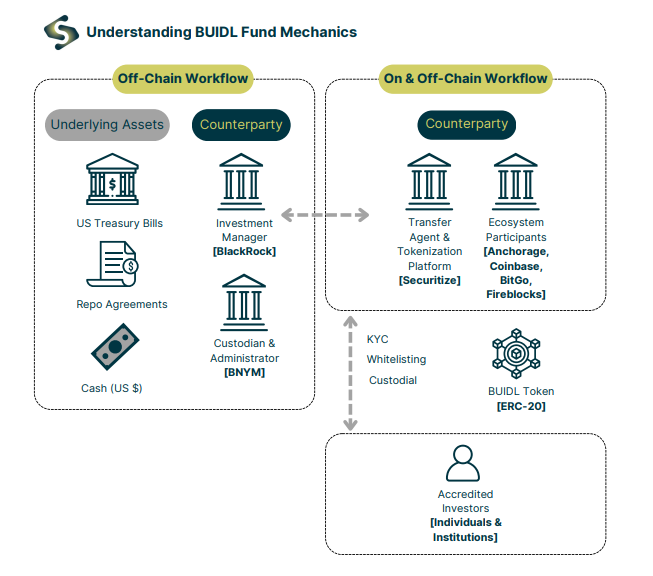
As previously mentioned, the BUIDL Fund is a traditional Money Market Fund that primarily invests in Cash and Cash Equivalents. In this case, the assets are allocated to U.S. Treasury Bills, Repurchase Agreements (Repo), and Cash. As the Fund provides daily liquidity, the fund manager likely invests in short-dated bills and repos to meet redemption requests without impacting the net asset value. Thus, the underlying assets of the BUIDL Fund are held off-chain within the traditional finance (TradFi) system. This method echoes the approach taken by Centralized Stablecoin projects like Tether and USDC.
However, it's important to note that the Fund does not invest in crypto-native assets. Consequently, the fund assets are not held in a crypto wallet for an extended period apart from being briefly accepted for investments in crypto assets.
The distinguishing feature of the BUIDL Fund is that its interests are issued as blockchain-based tokens, effectively tokenizing the Fund. These interests manifest as BUIDL tokens, adhering to the ERC-20 standard on the Ethereum network. As mentioned, the fund endeavors to maintain a stable value of $1 per token, positioning it as a yield-bearing stablecoin.
BlackRock Financial Management, Inc. operates as the investment manager for the BUIDL Fund. As a prominent publicly listed investment management firm, BlackRock boasts $10.0 trillion in Assets Under Management (AUM) as of December 31, 2023 [source]. Additionally, the Investment Manager is registered with the US Securities and Exchange Commission as an investment adviser under the Investment Advisers Act of 1940, as amended.
Bank of New York Mellon (BNY Mellon) serves as the custodian and administrator of the Fund's assets. This means that the underlying cash and other cash equivalent investments are held with this bank. BNY Mellon is the 11th largest bank in the U.S., with an AA- rating from Fitch Ratings.
The BUIDL fund interests are offered through Securitize Markets, LLC (Securitize), a registered broker-dealer and member of FINRA/SIPC.
Securitize is responsible for onboarding investors to the BUIDL fund. Anyone interested in investing in the BUIDL fund must do so through Securitize. To get started, investors need to create an account with Securitize. As a centralized custodial platform, Securitize conducts KYC (Know Your Customer) checks and wallet whitelisting as part of its onboarding process. Additionally, they monitor wallet activity to ensure compliance.
As the Transfer Agent, Securitize is responsible for maintaining the cap table and records of the Fund's interest holders and their holdings. They report to BlackRock through BalckRock's backend and investment management platform, Aladdin.
BlackRock has made a strategic investment in Securitize, granting them the right to appoint a director to Securitize's board.
The press release identified the following institutions as ecosystem participants: Anchorage, Coinbase, BitGo, and Fireblocks. They all provide custody services for crypto assets. Additionally, Coinbase operates as an exchange for both spot and derivative products, while Anchorage provides digital asset trading for institutions.
It is not clear what role these entities play in the BUIDL ecosystem, but they may provide digital asset custody services to Securitize. For instance, clients' BUIDL tokens may be held in custody by one or more of these entities, similar to a centralized exchange. This measure could be taken to ensure strong security for the assets in custody. However, since BUIDL is an ERC-20 token, investors should be able to self-custody their tokens with any compatible wallet.
It is possible that some of the ecosystem participants may offer fiat on- and off-ramp services. For example, suppose investors invest in the Fund with USDT or USDC. In that case, the USDT or USDC must be converted to fiat currency before the investment manager invests in the underlying assets, such as U.S. Treasury Bills. Similarly, if redemptions could be done back to USDT or USDC, then Securitize may need an on-ramp service to allow this. However, the information available is limited, and it is unclear whether creations and redemptions can allowed in stablecoins or other crypto assets.
It is unlikely that providers would allow a secondary market trading facility for BUIDL tokens, as they could be classified as securities. As a result, it is doubtful that BUIDL would have a liquid public market, particularly in the DeFi sector. However, a private market may exist even though liquidity could be highly fragmented. Consequently, investors would have to rely mostly on redemptions for liquidity.
Currently, there is no publicly available information regarding the reserve assets attestation or audits conducted by any third parties. Since the value of the BUIDL token is dependent on the value of the underlying pool of assets, token holders must be aware that the assets backing the BUIDL token are held in the Fund at all times. This service is essential, particularly since BUIDL is expected to maintain a stable value of $1 per token. Given that the Fund is a private entity, it's likely that these reserve attestations/audits are privately communicated to the investors.
We have noticed that some people point to a wallet address they believe belongs to BUIDL. However, this address may not actually belong to the BUIDL fund. Instead, it could belong to BlackRock. We base our speculation on several facts:
Firstly, BUIDL is not an on-chain fund. Instead, it holds its underlying assets in cash, U.S. Treasury Bills, and Repo Agreements held in custody with the Bank of New York Mellon. The Fund's interests are only represented on-chain via the BUIDL token. Therefore, if the funds in the claimed address belong to BUIDL, they should have left the address and been held in custody by BNY Mellon.
Secondly, a significant portion, 99,999,960 USDC, was received at that address on March 15th, 2024, whereas BUIDL was publicly launched on March 21st, 2024. Even if we assume that this USDC came to the BUIDL fund, then an equivalent amount of BUIDL tokens should have been issued to represent the investor's interest in the Fund. However, the Fund's first-day AUM was only $40 million, which rose to $100.5 million on March 22nd, 2024.
Finally, a fund aiming to deliver a yield to its holders would have deployed the funds immediately instead of holding them in a wallet address.
You can check the status of BUIDL in our Dune Dashboard by clicking on this link.
Assuming that the address was intended to seed the BUIDL fund, it is still unclear why the funds were not used according to the Fund's proposed investment strategy. Is this because the address received small amounts of various other tokens and some funds from Tornado?
There was a concern that the BUIDL fund's smart contract was not controlled by a multi-sig mechanism, which posed a single-point-of-failure risk. However, considering that the entire BUIDL structure is a centralized custodial solution, it can be argued that even with a multi-sig, that risk does not decrease. It is difficult to believe that outsiders would hold the keys to the multi-sig to the fund structure.
It is interesting to observe that BlackRock is not explicitly targeting its existing clientele with the BUIDL product. The primary target market appears to be crypto companies seeking treasury management solutions. For instance, USDM, a centralized stablecoin by Mountain Protocol, has expressed intentions to hold a portion of its reserves in BUIDL.
While there is speculation about potential use cases emerging in the future with the BUIDL as the central building block, such use cases are only remotely possible due to the permissioned access provided to BUIDL. For example, the tokens are transferable between whitelisted wallets.
However, one expected use case is that BUIDL could be used to create derivative products. Another is that investors could use BUIDL as collateral for borrowing purposes.
Although blockchain-based tokens are composable in any use case, there would be obstacles to using BUIDL in DeFi as a superior alternative to existing stablecoins.
BUIDL represents an intriguing development within the crypto space. However, it is not the first instance of tokenizing Real World Assets (RWAs). Currently, approximately $823 million in tokenized assets are in circulation. However, this amounts to only 0.5% of the total stablecoins market cap, which is $150 billion.
BUIDL is an interesting solution for centralized stablecoins due to their ability to manage reserve assets. Stablecoin projects can outsource their reserve management to BlackRock through BUIDL, subject to BUIDL's investment mandate. This allows stablecoin projects to avoid the hassle of active reserve management. Additionally, BUIDL is a blockchain asset, meaning that stablecoin projects can provide real-time proof of reserves online as opposed to the current attestation reporting, which is not real-time. There is also a growing demand from other centralized blockchain institutions to tokenize their treasury reserves, as evidenced by Matter Labs' recent decision to tokenize its treasury assets.
It is unclear whether DAO treasuries, with over $38 billion in treasury assets, would be interested in products like BUIDL. This is because most DAO treasuries hold significant value in their project's own tokens, which the DAO would want to avoid divesting to invest in BUIDL. Additionally, since DAO decisions are made through community voting, wider community acceptance of BUIDL as a suitable treasury management solution is necessary for there to be any real demand.
Dealing with stablecoin projects and DAOs may come with regulatory overhang for the BUIDL Fund. It will also be interesting to monitor demand shifts in response to market interest rate changes. The fund costs involved and the net yield achievable in a low-rate environment could make the Fund unattractive.
Finally, it should be noted that BUIDL is currently a tokenized blockchain asset issued within traditional financial silos with limited use cases. It is a permissioned and closed asset on open blockchain rails, making it unattractive to the broader crypto ecosystem at this time. As a result, it currently only appeals to a segment of cryptocurrency firms.
We value your feedback and strive to enhance our content and offerings based on your suggestions. Let us know what you enjoyed about this short article and if there is anything we may have overlooked. We're eager to receive feedback and encourage you to share your thoughts with us at research@sqrr.xyz.
The document generated by SQRR is for informational purposes only and should not be considered financial, investment, or legal advice, or an offer or the solicitation of an offer to buy or sell securities or other assets. Users of this document should always do their independent research before making any decisions. Furthermore, SQRR is not responsible for any errors or omissions, nor for any loss or damage of any kind, including without limitation any direct, indirect or consequential loss or damage, arising out of or in connection with the use of this document. Any decisions based on information contained in this document are the sole responsibility of the reader.
No guarantee is made for the accuracy or completeness of any information provided in the document. Any opinions, estimates, or recommendations expressed herein are subject to change without notice and constitute judgment as of the date of publication.
In this report, any mention of a particular project, commercial product, process, brand, or service, or the use of any trade, firm, or corporation name is solely for the purpose of providing information and convenience to the readers. It should not be interpreted as an endorsement, recommendation, or preference by SQRR.