

PayPal made headlines when they announced the launch of their Stablecoin, PayPal USD (PYUSD), on August 7th, 2023. PayPal is not new to the cryptocurrency space; they already allow their customers in certain markets to buy, hold, sell, receive, and send certain cryptocurrencies and use the proceeds from sales of cryptocurrencies to pay for purchases at checkout. These cryptocurrencies consist of Bitcoin, Ethereum, Bitcoin Cash, and Litecoin. However, the mission behind PYUSD was to deploy a safe, regulated stablecoin at scale for both the web3 ecosystem and everyday payments. PayPal is notable for its user base of 400 million active users and 35 million merchant partners. The primary market for this $64 billion company is the US, which accounted for 57% of its revenue in FY2022. The UK accounted for 8%, while the rest of the revenue came from other countries. According to its Crypto Assets Safeguarding Liability on the financials, as of the end of FY2022, PayPal's users held approximately $604 million worth of cryptocurrencies.
PayPal, a global commerce and payment giant, has shown interest in blockchain and cryptocurrency for several years. In October 2020, they obtained a conditional BitLicense from the New York Department of Financial Services (NYDFS), which has since been granted a full license. In addition, they established an advisory council on Blockchain, Crypto, and Digital Currencies (BCDC) with leading personnel. With the BitLicense in place, they launched a new service allowing customers to buy, hold, and sell cryptocurrency directly from their PayPal account. They also extended their services to support the transfer of cryptocurrencies between PayPal and other wallets and exchanges. In early 2022, reports emerged that PayPal was exploring the launch of its own Stablecoin, but these plans were later put on hold. Regardless, the launch of PYUSD in August came with more formalities in place, as discussed below. The launch seems to have received criticism from lawmakers. However, in his statement regarding the PayPal announcement, Patrick McHenry, the Chairman of the House Financial Services Committee, stated, "This announcement is a clear signal that stablecoins - if issued under a clear regulatory framework - hold promise as a pillar of our 21st century payments system."
In terms of market growth, PayPal wouldn't want to miss out on the rise of Stablecoins. The figure below shows that Stablecoins has caught up with established players and reached nearly similar volumes as Visa by 2022. Stablecoin settlements overtook PayPal's values in early 2020.
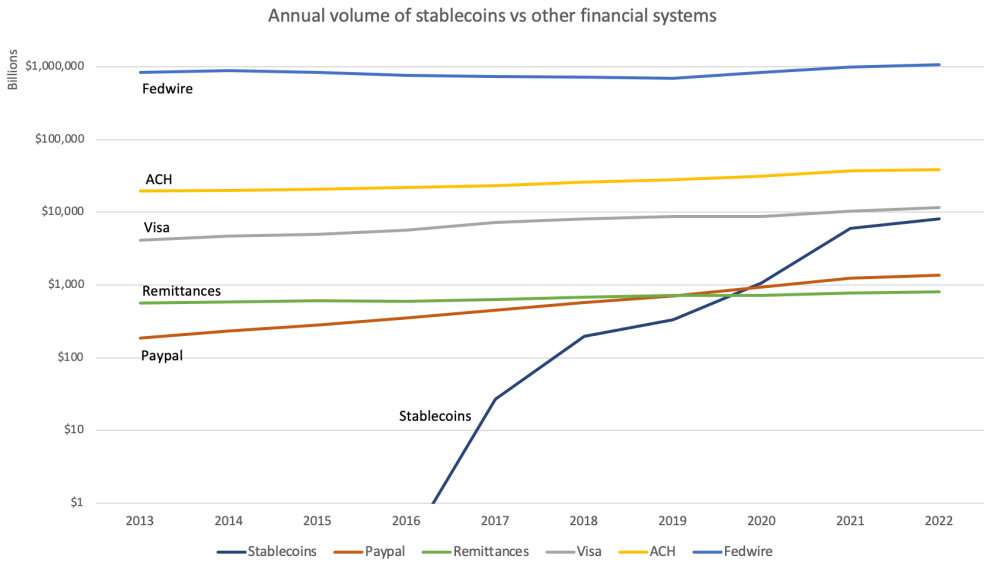
Source: Nic Carter, Slide Deck of the talk given at the Token 2049 Singapore.September 2023, “Regime Change in Stablecoins.”
Furthermore, the Stablecoin business model appears to be highly profitable. Tether reported over $1 billion in operational profits for Q2 2023, reflecting a 30% quarter-over-quarter increase.
PayPal USD (PYUSD) is a Fiat-Backed Stablecoin denominated in U.S. dollars. PayPal USD is 100% backed by U.S. dollar deposits, short-term U.S. Treasuries, and similar cash equivalents. PYUSD is redeemable 1:1 for U.S. dollars and is issued by Paxos Trust Company.
Being a Stablecoin that is issued under DFS oversight, there are three key requirements that PayPal is expected to meet concerning U.S. dollar-backed stablecoins, i.e., backing and redeemability, reserve, and attestation. These guidelines are outlined in the "Guidance on the Issuance of U.S. Dollar-Backed Stablecoins." PYUSD is one of the six stablecoins listed in the DFS Greenlist.
PYUSD is an ERC-20 token on the Ethereum blockchain, with any interactions with PayPal USD occurring at the address of the proxy at 0x6c3ea9036406852006290770bedfcaba0e23a0e8 (with 6 decimals. Note that the Attestation Report for August mentions 18 decimals, likely due to an oversight). As per the requirements of the DFS, Paxos releases regular Attestation Reports (monthly and annual) issued by WithumSmith+Brown, PC, an independent third-party accounting firm. Additionally, Paxos self-reports its portfolio composition five business days after the month’s end. Trail of Bits conducted a security audit of the PYUSD token contract, previously known as Token Hopper/XYZ, in December 2022. You can view the repository for the PYUSD stablecoin smart contract here.
To monitor the on-chain activity of PYUSD, we created a Dune Dashboard. Below are some of the key metrics we track. To view the most recent data, please access the Dashboard by clicking this link.
Currently, 94.4 million PYUSD tokens are issued on the Ethereum blockchain, held by around 1,000 addresses. However, most of these tokens are held by addresses belonging to Crypto.com, which recently announced its partnership with PayPal and Paxos to establish Crypto.com as a preferred PayPal USD (PYUSD) exchange, and Paxos. About 10% of the remaining tokens are deposited in CEXs, DEX (Uniswap), and held by other addresses.
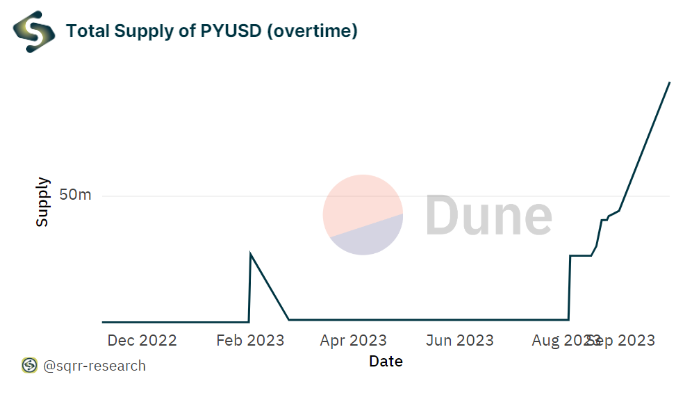
Source: SQRR Research. Data: Dune Dashboard.
According to the data, the total trading volume of PYUSD has reached approximately USD 9.2 million. While the PYUSD-WETH pair had a higher percentage of volume in the early days, currently, the PYUSD-USDT and PYUSD-USDC pairs have become the dominant pairs in terms of traded volume.
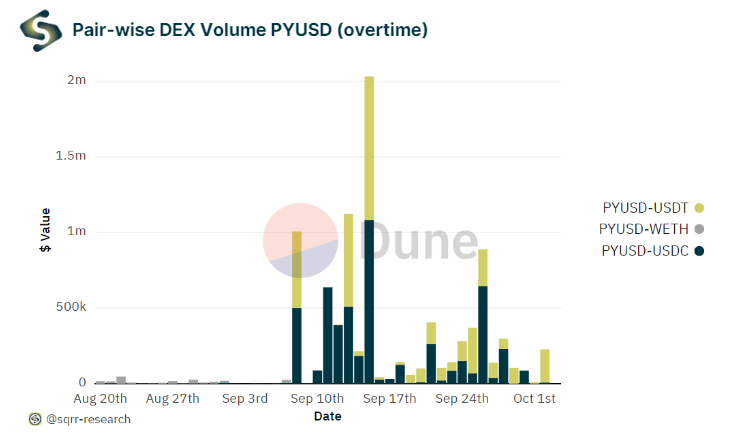
Source: SQRR Research. Data: Dune Dashboard.
Based on the Attestation Report of August 2023, the total reserve accounts have exceeded the total supply of PYUSD. The report attests that 97% of the reserve assets consisted of U.S. Government Guaranteed Debt instruments (specifically, Overnight Reverse Repurchase Agreements), while the remaining assets were in U.S. Dollars.
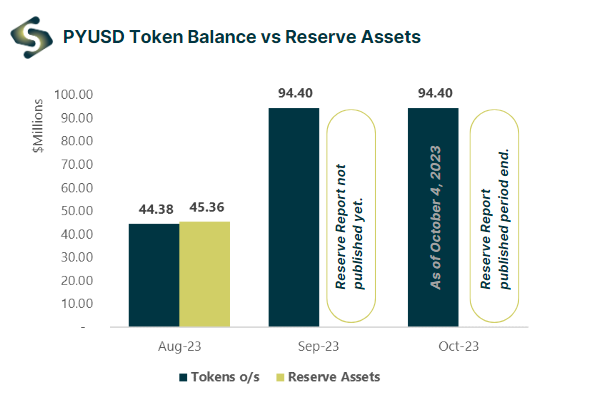
Source: SQRR Research. Data: Dune Dashboard, Paxos Transparency Reports.
During our on-chain data analysis, we discovered several fake PYUSD contracts that were deployed on Ethereum around the same time that PayPal announced its Stablecoin. It is crucial to exercise extreme caution when dealing with PYUSD to confirm that you are interacting with the official PayPal contract.
PayPal's decision to launch a stablecoin for facilitating payments is a noteworthy move towards providing its vast global customer base with a faster and more convenient settlement option. From an Ethereum blockchain perspective, the adoption of PYUSD by PayPal users and merchants could result in billions, if not trillions, of total payment volume being settled on the blockchain. This is a positive development for both PayPal and the Ethereum blockchain ecosystem.
It is worth mentioning that the PYUSD stablecoin has been launched with a strong regulatory structure, as both PayPal and Paxos (the issuer) operate under NYDFS licenses. As a centralized stablecoin, this can be seen as a positive step. However, the regulatory landscape is still evolving, and it is difficult to predict future regulatory changes that may affect PayPal and its PYUSD. In recent times, stablecoins based in the US have encountered a decrease in growth, which is believed to be partly attributed to regulatory pressure.
It is worth noting that while PayPal's launch of a stablecoin is a positive development for both PayPal and the centralized payments sector, as well as the blockchain industry (particularly Ethereum), it is still too early to make any definitive conclusions based on the available data. We will continue monitoring the on-chain data closely to understand any further developments, and we invite you to check out our Dune Dashboard for yourself.
We value your feedback and strive to enhance our content and offerings based on your suggestions. Let us know what you enjoyed about this short article and if there is anything we may have overlooked. We're eager to receive feedback and encourage you to share your thoughts with us at research@sqrr.xyz.
The document generated by SQRR is for informational purposes only and should not be considered financial, investment, or legal advice, or an offer or the solicitation of an offer to buy or sell securities or other assets. Users of this document should always do their independent research before making any decisions. Furthermore, SQRR is not responsible for any errors or omissions, nor for any loss or damage of any kind, including without limitation any direct, indirect or consequential loss or damage, arising out of or in connection with the use of this document. Any decisions based on information contained in this document are the sole responsibility of the reader.
No guarantee is made for the accuracy or completeness of any information provided in the document. Any opinions, estimates, or recommendations expressed herein are subject to change without notice and constitute judgment as of the date of publication.
In this report, any mention of a particular project, commercial product, process, brand, or service, or the use of any trade, firm, or corporation name is solely for the purpose of providing information and convenience to the readers. It should not be interpreted as an endorsement, recommendation, or preference by SQRR.